Inspiration from my bookshelf, Inspired, Uncategorized

Visceral Manipulation 内臓マニピュレーション

IMG_4087[1]Visceral Manipulation(VM) is one of very effective techniques I often use especially for those patients I treat at Northside’s St Leonards/Cremorne. After the treatment, most patients ask me “what kind of massage therapy was that?” and they say “It’s so different, so relaxing, and I feel so deep something changed and changing…”  Their feedback are always such rewarding and great driving force for a therapist to keep going, keep learning and exploring the depth of our existence as human forms visible and invisible.

病院内のクリニックで入院患者さんへの施術に際してよく使うテクニックの中に、内臓マニピュレーション(VM)がある。施術を受けた患者さんの多くが、「今のは何というマッサージセラピー?」「全く違う感覚。とてもリラックスできて、体の深いところで何かが変わったというか、変わり続けてる感じがする」と言う。こうした患者さんからのフィードバックが、施術者にとっては何よりも大きな励みであり、目に見える形としての人体、目に見えない人間としての存在の深みを探り、学び続ける意欲と勇気の源となる。

Visceral Manipulation is a manual therapy consisting of gentle, specifically placed manual forces that encourage normal mobility, tone and inherent tissue motion of the viscera, their connective tissue and other area of the body where physiological motion impaired.

内臓マニピュレーションとは、内臓や結合組織、そのほか体のいろいろな部分で生物学的な動作が阻害されている箇所に、ピンポイントで柔らかく、しかし最適な刺激を与えることで、これらの本来あるべき動きや柔軟性の回復を助けるマニュアル・セラピー(徒手治療)である。

VM has been developed and being taught in many countries by its founder Dr.of Osteopathy  Jean-Pierre Barral and his team of professional instructors and certified practitioners. Dr. Jean-Pierre Barral, born on 25 Sep. 1944 in France, developed visceral listening technique through his observation and discovery that extensive tissue thickening around viscera was causing an altered mechanical tension on surrounding tissues while he was working at the Lung Disease Hospital. Through his intensive work and research, he came to see the significant relationship between viscera and somatic dysfunction, and discovered structural relationships(musculoskeletal, spinal, cranial) would self correct after proper Visceral Manipulation. He says, “the purpose of VM is to recreate, harmonise and increase proprioceptive communication in the body to enhance its internal mechanism for better health”

VMは、オステオパシーを専門とする医療従事者ジーン・ピエール・バラル氏によって開発され、同氏のもとに養成された指導者や医療従事者から成るチームによって、さまざまな国で教えられている。バラル氏は1944年9月25日、フランス生まれ。地元の肺病専門病院での患者の治療や解剖業務に従事する中、内臓周辺の細胞が極端に厚くなることでその周辺部分の機能的な緊張具合に影響することに気づき、内臓リスニング*(患者の体に負荷なく手を置き、手のひらに伝わる動きを通して、問題個所を探し当てていく方法を、VMではリスニング「聴き取り」と呼ぶ)テクニックを習得していった。さらに日々の業務と研究を進めながら、内臓と身体の機能障害に深い関連性があることを確認し、的確な内臓マニピュレーションを施すと、構造的な関係性(筋骨格、脊柱、頭蓋)は自ずと修正するようになることを見出した。同氏は言う、「内臓マニピュレーションの目的は、体内の固有受容感覚的コミュニケーション*(それぞれの臓器などの位置感覚ほかを通した相互作用網)を再構築し、調和させ、増幅させることで、内的な機能を高め、よりよい健康をもたらすことにある」。
 

にほんご版, Inspiration from my bookshelf, Uncategorized

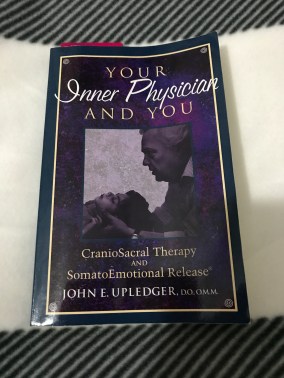
頭蓋仙骨療法のJOHN E. UPLEDGER 著

“Your Inner Physician and You”  

IMG_2062

     CranioSacral Therapy and        SomatoEmotional Release

 1997年発行

第12章   Insights から

CranioSacral Therapyの生みの親である著者アプレッジャー氏は、当著62頁12章「洞察」の中で、慢性的な痛みやそのほかの疾患治療に長年専心的にかかわる中、細胞記憶、エネルギーシスト、ソマト・エモーショナル・リリース(体性感情解放)など、今でこそよく耳にするようになったこうした概念のほか、施術を行う人の意志や信念、手で触れること(Touch)の効果や影響の大きさ、医療行為の一環として用いるイメージ化や対話に秘められた力、こうした施術力のある人物の資質など、さまざまな奥義が見えてきたと述べています。(13章以降で各項目について述べられています)

中でも、潜在的な自己治癒力が十分に発揮できないその背景には、自己治癒力に関する何らかの否定的な思いがどこかにあるようだと、この本を書いた今から20年ほど前に示唆しています。

アプレッジャー氏は、自分が患者を治す(Cure)のだと信じていた以前の自分は、医者として未熟でり、思いあがっていたと述懐。しかし、患者こそHealingの主体であり、自分はその治癒力(Healing)を引き出すファシリテーターとして、各患者の治癒行程を見守り、伴走できることをありがたいと思い、医者である自分は生徒であって、患者は師であると静かに説いています。


Inspiration from my bookshelf

TRIGGER POINT THERAPY

trigger pointfor Myofascial Pain       The Practice of Informed Touch

by Donna Finando, L.Ac., L.M.T & Steven Finando, Ph.D.,L.Ac.

Extract from Chapter 3,  INFORMED TOUCH

….Training of the hands begins with bringing awareness to them. Practice placing your awareness in your hands. The ongoing effort to intentionally connect your mind to your hands is the key to successful training……Touch with attention – all touch explorations begin with this new focus…..

…The second essential requirement for the development of excellent palpation skills is the presence of a clear mental image of the structures being palpated. This requirement cannot be emphasized enough. You must be able to clearly visualize the anatomic structures of the human form as you try to palpate. It is therefore necessary to study the anatomy of musculoskeletal system. A keen knowledge of skeletal structure and the attachments, fiber  direction, and function of each muscle is essential. Begin with knowledge, the idea, and the image, and then train your hands to “see” what you know is there……..

Inspiration from my bookshelf

TRIGGER POINT THERAPY

trigger pointfor Myofascial Pain       The Practice of Informed Touch

by Donna Finando, L.Ac., L.M.T & Steven Finando, Ph.D.,L.Ac.

Extract from Chapter 2,    QI, MOVEMENT, AND HEALTH

…..Perhaps most intriguing and powerful aspect of Oriental medicine is its direct connection to universal principles. The Taoist application of cosmology to human health – the view of the human being as a part of a much broader universal system – is foundational to understanding the ancient Oriental approach to health care. Seeing the human being as a microsystem that is part of a macrosystem is intrinsic to understanding how to treat health problem…..

…….. Health requires movement; when movement ceases, life ceases…..

….Qi, like other metaconcept, is in the same category of definitional complexity. However, once we relate the concept of qi to movement, we hold a rather elegant idea that bridges Eastern and Western views of life and health.

Myofascial meridian therapy operates from this simple unifying construct. Movement, harmonious activity, unimpeded flow of bodily fluids, unimpeded nerve transmission, and the free range of motion of muscles and joints are all connected to health and life.

Given the functional definition of qi as movement, myofascial meridian therapy is concerned not with “moving” some substance called qi, but rather with removing or minimizing disruptions to movement itself. Our inclination is to trust the inherent wisdom of the body, we endeavour to provide an optimum environment in which the body can heal itself……..

….Myofascial meridian therapy is concerned with constriction not only in the muscles but also in the fascia. The fascia is unique in human physiology, existing as a single continuous sheath that extends from the head to the toes, encasing every organ, muscle, and muscle fiber as it winds through the body…..

…..Doctor of osteopathy John Upledger describes the fascia as “a maze which allows travel from any one place in the body to any other place without ever leaving the fascia”….

Inspiration from my bookshelf

Foundations of Massage

IMG_1619

Foundations of Massage

Authors: Lisa Casanelia & David Stelfox

Extract from Chapter 4 – the importance of touch – Sheena Worrall

….Smith states that this kind of tactile interaction has profound effects on the neuroendocrine system, making it possible for animals that are naturally excitable and aggressive to live calmly in close proximity to one another (Smith 2000:92). Like other primates, humans also seem to find touch an important way to bond, communicate and enjoy positive experience together.

An act of touch as simple as holding someone’s hand can have a major impact on their physiological and psychological state.

…..The profession of massage is a caring one. Massage therapy addresses the need for positive sensory experiences and comfort. Physical contact through positive touch may foster a powerful sense of connection and caring. This sense of connection with the environment and other people may be an important source of strength and comfort of humans. Massage therapy can help with this.

Physiotherapy educator Gjertrud Roxendal claims that massage is communication. She believes that the therapist, in caring for the client, is sending messages via the skin, especially the question: ‘How are you?’ The client receives the care and in turn answers via changes to breathing, muscle tension and skin reactions. Roxendal also believes that massage confirms the receiver through the body. The fact that the therapist is prepared to touch the client confers on them acceptance and validation as a person (Roxendal 1990).

…. A lot of the psychological benefits of massage therapy seem to relate to the establishment of a close and trusting relationship between client and therapist. Positive touch engenders a sense of confidence in the therapist (De Domenico & Wood 1997) and demonstrates caring and concern. Massage can evoke feelings of acceptance and respect for the body and psyche of the person being touched (McCabe 2001). ……..